

Truck accident cases are rarely simple. A crash involving a commercial vehicle can leave victims with severe injuries, long recovery periods, lost income, and major financial pressure. In many cases, the first question people ask is whether the truck driver made a mistake. That matters, but it is not the whole picture. In 2026, one of the most important issues in serious trucking cases is whether the driver was properly trained in the first place. That is where an Orange County truck accident lawyer may uncover deeper evidence of negligence.
This issue has become more relevant because federal authorities recently announced the closure of more than 550 commercial driving schools after finding serious safety failures. Investigators reported problems such as unqualified instructors and inadequate testing. That development matters because poor training does not stay in the classroom. It can show up later on California roads in the form of unsafe lane changes, rollover crashes, rear-end collisions, jackknife accidents, and cargo-related incidents.
When a trucking company puts an undertrained driver on the road, the company may share responsibility for the crash. In some cases, negligent training can become one of the strongest parts of the injury claim.
Why Truck Driver Training Matters in Accident Cases
Commercial trucks are not like passenger vehicles. They take longer to stop, require more skill to turn safely, create larger blind spots, and demand better judgment in traffic, weather, braking, lane positioning, and cargo handling. Because of that, truck drivers are expected to meet training and qualification standards that go beyond the basics of ordinary driving.
The Federal Motor Carrier Safety Administration (FMCSA) continues to describe its Entry-Level Driver Training rules as the baseline training requirements for entry-level commercial drivers. These rules exist to improve safety and help ensure that drivers are qualified before operating commercial motor vehicles on public roads. If a driver was poorly trained, rushed through instruction, or placed behind the wheel without adequate preparation, that failure can become highly relevant after a collision.
For injury victims, this means the case may involve more than proving one driver made one bad decision. It may involve showing that the employer or training provider contributed to the danger long before the crash happened.
What Negligent Training Can Look Like
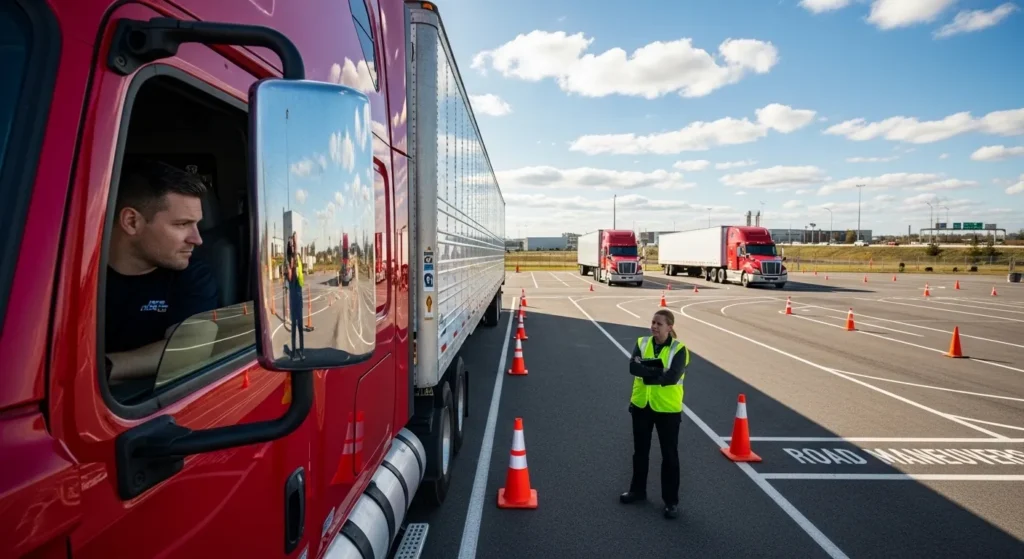
Negligent training is not always obvious right away. Sometimes it shows up in the driver’s actions at the crash scene. Other times it appears later through records, testimony, or violations found during the investigation. Common examples include:
- Inadequate instruction on stopping distance and speed management
- Poor training on blind spots, turns, and merging
- Failure to properly train on backing and maneuvering
- Insufficient instruction on cargo securement or weight distribution
- Weak preparation for driving in rain, wind, or reduced visibility
- Placing a driver on the road without verifying true competence
- Using unqualified instructors or incomplete training records
These failures can directly contribute to severe crashes. A truck driver who has not been properly trained to manage stopping distance in traffic may cause a devastating rear-end crash. A driver who lacks proper turning or backing instruction may strike another vehicle, a pedestrian, or roadside property. Poor training is not just a paperwork issue. It can become a real-world safety failure.
How a Trucking Company Can Be Liable
Many people assume only the truck driver can be sued after a crash. That is wrong. Trucking companies may be legally responsible when they hire unqualified drivers, fail to supervise them, ignore red flags, or put them on the road without proper training. In some cases, the employer’s conduct is actually more important than the driver’s momentary mistake.
If a company cut corners to save time or money, skipped proper onboarding, relied on bad training providers, or failed to confirm that the driver was actually qualified, those facts can support a stronger injury claim. This is especially important in catastrophic cases involving spinal injuries, brain injuries, multiple surgeries, or permanent disability.
That is one reason victims should not rely only on the police report. A police report may describe what happened on the road, but it usually does not reveal the full story about hiring, training, supervision, and safety culture inside the trucking operation.
What Evidence Can Help Prove Negligent Training?
An Orange County truck accident lawyer may investigate a wide range of evidence to determine whether training failures played a role in the crash. Useful evidence can include:
- Driver qualification files
- Training certificates and course completion records
- Instructor qualifications
- Hours-of-service and logbook records
- Electronic logging device data
- Prior safety violations or employer discipline records
- Dispatch communications and company policies
- Crash reconstruction findings
These records can show whether the driver was adequately prepared, whether the company followed federal standards, and whether the crash was part of a broader safety failure instead of a one-time mistake.
This topic pairs naturally with your existing article on truck inspection reports in truck accident cases, because both posts focus on evidence that can reveal deeper negligence. It also fits well with the role of surveillance cameras in truck accident investigations, since video footage may help show whether the driver handled the truck in a way that suggests poor training or poor judgment.
Why 2026 Makes This Topic More Important
This issue is more than theoretical. In February 2026, federal officials announced that more than 550 commercial driving schools would be shut down after inspections found serious problems, including unqualified instructors and inadequate testing. That enforcement action followed a broader safety push around commercial driver qualification and training oversight.
For truck accident victims, this matters because it shows that training quality is not just an abstract compliance issue. Regulators themselves are saying there are serious gaps in parts of the system. When a badly trained driver causes a crash, the victim should not have to absorb the consequences alone.
FMCSA’s Entry-Level Driver Training program is still presented as the minimum baseline for new commercial drivers. California’s CHP Commercial Vehicle Section also emphasizes commercial vehicle safety through enforcement, education, and prevention efforts. Those official safety standards can help frame what should have happened before the crash ever occurred.
How This Affects Fault and Compensation

Negligent training can strengthen fault arguments because it broadens the case beyond the driver’s immediate actions. Instead of arguing only about whether the driver braked too late or changed lanes unsafely, the claim may also show that the trucking company failed at a higher level. That can help explain why the crash happened and why the employer should be held accountable.
It can also affect compensation. If the evidence shows systemic negligence, the case may become more valuable because it supports a clearer liability narrative. This can matter when pursuing damages for medical bills, rehabilitation, lost income, reduced earning capacity, pain and suffering, and long-term care needs.
For readers trying to understand the damages side, this article should link naturally to what compensation you can receive after a truck accident in Orange County. It also supports how to prove fault in a truck accident in Orange County, because negligent training is one of the many ways fault can be established.
What Victims Should Do After a Serious Truck Crash
If you believe a truck driver may have been poorly trained, do not try to investigate the case alone. Trucking companies and insurers move quickly after major crashes. Important records may disappear, witnesses may become harder to locate, and electronic data may not be preserved unless action is taken early.
Victims should get medical care immediately, preserve photos and videos, avoid careless insurance statements, and speak with counsel as soon as possible. A lawyer can send preservation letters, request safety records, and begin examining whether the company followed federal training and qualification rules.
Final Thoughts
Truck accident cases are often more complicated than they first appear. In 2026, negligent driver training is one of the clearest examples of that. When a trucking company places an undertrained or improperly qualified driver on Orange County roads, the risk does not fall only on the company. It falls on every driver, passenger, cyclist, and pedestrian nearby.
An Orange County truck accident lawyer can investigate whether poor training, weak supervision, or FMCSA-related failures contributed to the crash. That kind of investigation can make a major difference in proving liability and recovering full compensation after a devastating collision.
For official background, readers can review the FMCSA Entry-Level Driver Training page and the CHP Commercial Vehicle Section.