
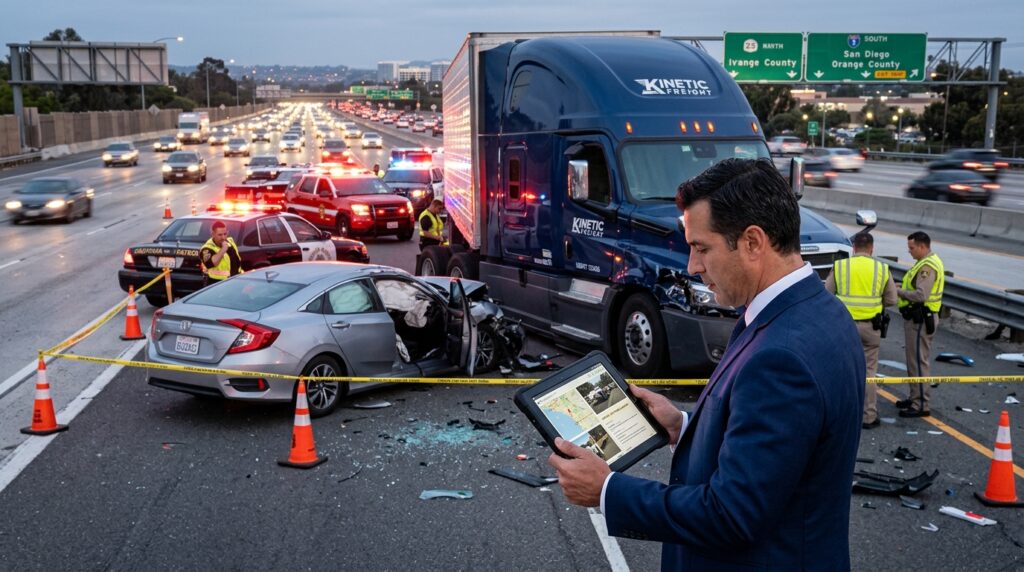
The truck crash study now moving through FMCSA matters because serious commercial vehicle crashes rarely have one simple cause. A truck driver may brake late, but the deeper story may involve fatigue, dispatch pressure, poor maintenance, unsafe cargo, or company-level safety failures. For injured victims in Orange County, that deeper investigation can change the direction of a claim.
FMCSA’s Crash Causal Factors Program focuses on why crashes happen, not only where they happen. The agency’s current heavy-duty truck study collects detailed information about fatal crashes involving Class 7 and Class 8 trucks. These vehicles include semi-trucks, tractor-trailers, cement trucks, garbage trucks, and heavy freight vehicles.
For local victims, the point is practical. A crash on I-5, I-405, SR-55, SR-57, SR-91, or near an Orange County warehouse route may involve more than a police report can capture. The truck crash study highlights the same question a strong legal investigation should ask: what driver, vehicle, motor carrier, roadway, and environmental factors contributed to the collision?
Your existing article on how to prove fault in a truck accident in Orange County already explains why evidence matters. This post builds on that idea by showing how crash-causation thinking can help victims look beyond the obvious impact point.
Why The FMCSA Truck Crash Study Matters In 2026
The trucking industry has changed a lot since older large truck crash research. Trucks now use more electronic systems, telematics, cameras, driver-assistance tools, and digital records. At the same time, delivery pressure, warehouse growth, port traffic, e-commerce demand, and driver shortages continue to affect commercial transportation.
That is why a modern truck crash study can matter to injury claims. It reminds victims not to accept a shallow explanation too quickly. A trucking company may say the driver made a mistake. An insurance adjuster may blame traffic. Another driver may say the truck “came out of nowhere.” Those statements may describe part of the crash, but not the full chain of events.
Crash causation looks beyond the final seconds
A truck accident often begins long before impact. A driver may have started the route tired. A carrier may have ignored warning signs in driver logs. A dispatcher may have pushed an unrealistic delivery window. A maintenance company may have missed brake or tire problems. A cargo loader may have created an unstable load.
When investigators look only at the last few seconds, they may miss those causes. A crash-causation approach asks better questions. How long had the driver been working? Did the truck pass inspection? Did the company monitor safety alerts? Did road conditions, construction zones, or traffic patterns play a role?
Driver behavior is only one part of the story
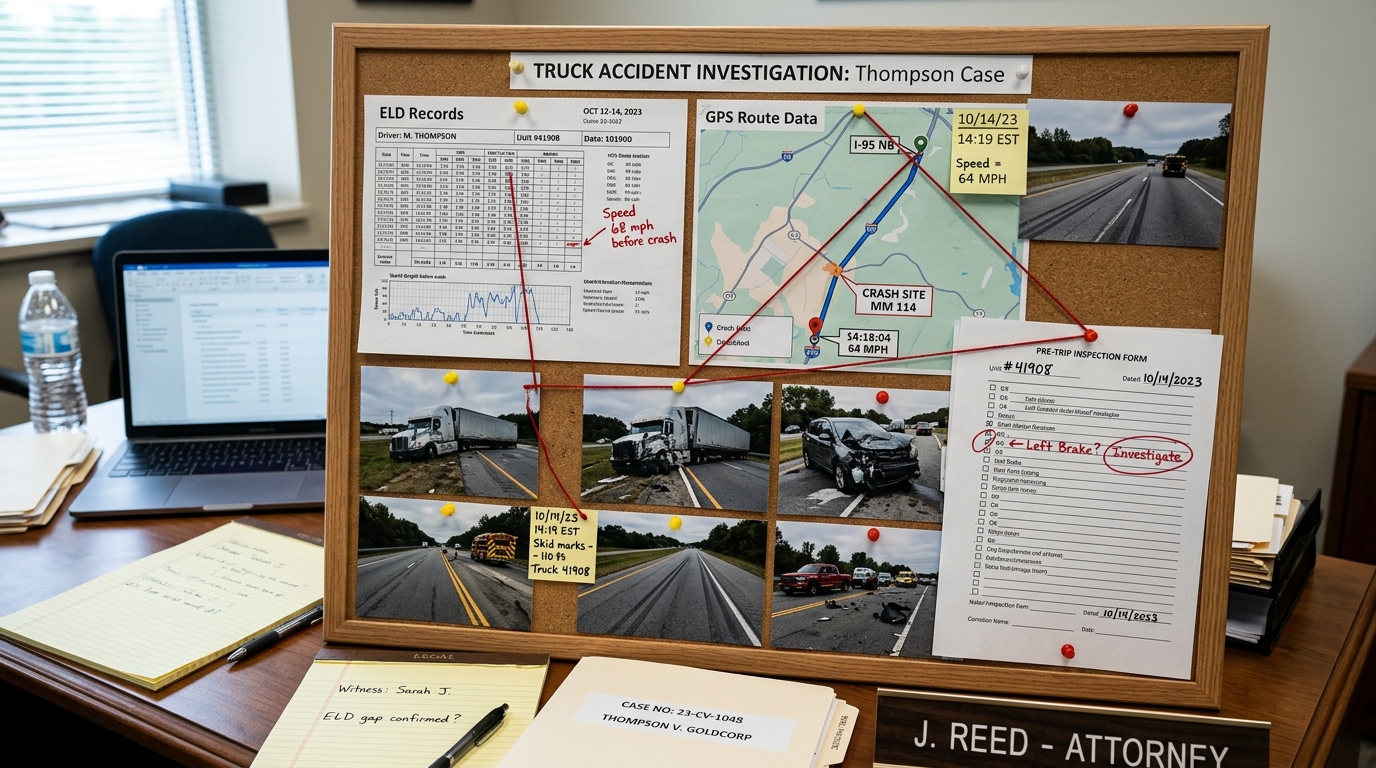
Truck drivers can cause serious crashes through speeding, distraction, unsafe lane changes, fatigue, impairment, or following too closely. Still, driver behavior may connect to broader company conduct. If a carrier rewards fast deliveries but ignores rest breaks, the company may share responsibility. Poor training can also leave a driver unprepared for Orange County freeway conditions.
This matters because compensation can depend on identifying all responsible parties. A claim may involve the driver, motor carrier, broker, shipper, trailer owner, maintenance vendor, cargo loader, or vehicle manufacturer. Your post on understanding liability in truck accident cases supports this point.
Orange County truck routes create unique evidence issues
Orange County has heavy commercial traffic moving between ports, warehouses, construction sites, retail centers, and major freeway corridors. A crash near an interchange may involve congestion, lane merging, tight delivery windows, or sudden stopping. A collision near a loading area may involve unsafe backing, poor visibility, or unclear traffic control.
These local details matter. A truck crash in open rural traffic differs from a crash near the 405 during peak congestion. The same is true for construction zones, delivery entrances, industrial streets, and freeway ramps. A strong investigation should match the evidence to the location.
Scene evidence can disappear quickly
Victims should document the scene as soon as it is safe. Photos can show skid marks, debris, lane markings, traffic signs, vehicle positions, trailer numbers, DOT numbers, company names, cargo conditions, lighting, weather, and visible damage. Nearby businesses, freeway cameras, dashcams, and intersection cameras may also hold video.
Delay can hurt the claim. Road debris gets cleared. Vehicles move. Cameras overwrite footage. Witnesses forget details. Trucking companies may repair equipment and continue operations. Your guide on surveillance cameras in truck accident investigations adds more detail on video evidence.
How Crash-Causation Evidence Can Strengthen A Claim
A serious truck claim should connect the crash, the injuries, and the responsible conduct. The truck crash study topic helps readers understand why lawyers often request many records, not just the police report.
For official background, readers can review FMCSA’s Crash Causal Factors Program here: FMCSA Crash Causal Factors Program. The page explains that the heavy-duty truck study focuses on driver, vehicle, motor carrier, and environmental factors in fatal heavy-duty truck crashes.
Records that may reveal the real cause
Important records may include ELD data, driver qualification files, dispatch messages, GPS records, inspection reports, maintenance logs, dashcam footage, trip sheets, bills of lading, broker communications, and repair records. These documents can show whether the company followed safety rules or ignored warning signs.
Electronic records deserve special attention. ELD data may show driving time and rest breaks. GPS records may reveal speed, route changes, and stops. Dashcam footage may show braking, lane position, following distance, or distraction. If those records conflict with the company’s story, the victim may have stronger grounds to challenge the insurer.
Preservation letters can protect key truck data

A lawyer may send a preservation letter after a serious crash. This notice tells the truck driver, carrier, insurer, broker, shipper, or related parties to keep important evidence. It may request ELD data, dashcam video, inspection records, maintenance files, driver logs, safety policies, testing records, and dispatch communications.
This step matters because truck data may not stay available forever. Some systems overwrite footage or electronic records. Companies may move trucks back into service. Repair work may change physical evidence. Your article on ELD truck accident evidence in Orange County pairs well with this topic because driving-time records can reveal fatigue and schedule pressure.
Medical proof still matters as much as crash proof
Even strong crash evidence will not carry a claim without medical documentation. Victims should get treatment, follow medical advice, keep appointment records, save bills, and track symptoms. Serious truck crash injuries can affect daily life long after the scene clears.
Insurance companies may still question the injury, treatment, or connection between the crash and symptoms. Good medical records help answer those arguments. Employment records, wage documents, therapy notes, prescription records, and pain journals can also support damages.
The main lesson from the truck crash study conversation is simple: do not let anyone reduce a serious truck crash to one sentence. A commercial vehicle collision may involve driver mistakes, company pressure, equipment problems, poor supervision, and local road conditions.
If you suffered injuries in an Orange County truck crash, act quickly. Get medical care, document the scene, save every record, avoid rushed insurance statements, and make sure the truck’s electronic and company evidence gets preserved before it disappears.