
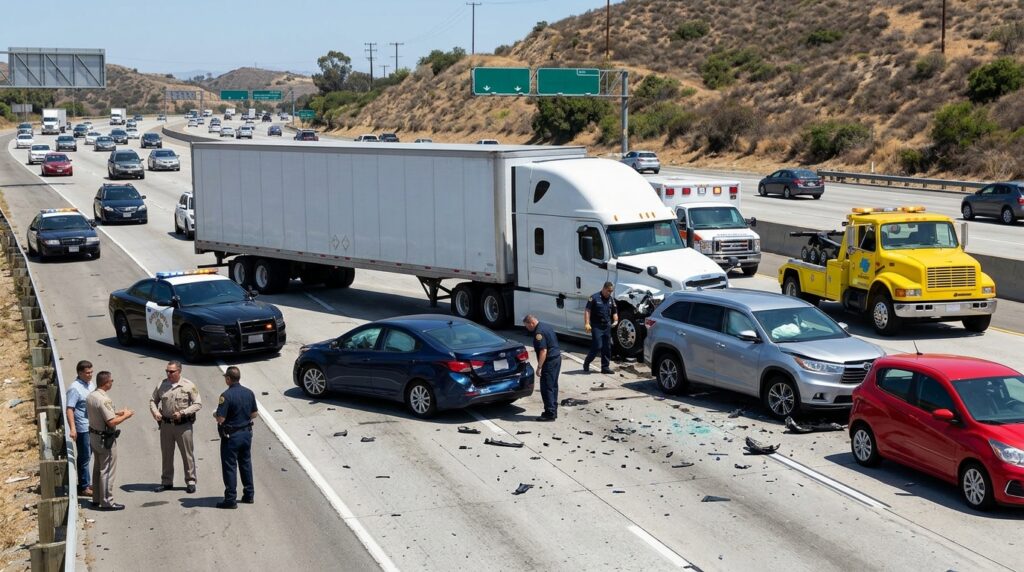
Chain-reaction truck crashes in Southern California can turn one dangerous moment into a pileup involving several vehicles, multiple injury victims, and several insurance companies. These cases are rarely simple. A semi-truck may rear-end stopped traffic, cross lanes after a tire failure, jackknife near an interchange, lose cargo, or trigger sudden braking that causes other vehicles to collide behind it.
For Orange County drivers, the risk is easy to understand. Freeways such as I-5, I-405, SR-55, SR-57, SR-91, and nearby freight corridors carry heavy commercial traffic every day. A truck crash near a merge, construction zone, exit ramp, or traffic queue can quickly involve commuters, rideshare passengers, delivery drivers, tourists, motorcyclists, and families.
These crashes also create legal complications. Each driver may have a different view of what happened. The trucking company may blame traffic. Another driver may blame the vehicle behind them. An insurer may argue that the truck was only one part of the crash. For injured victims, the main challenge is proving how the chain reaction started and which parties contributed to the harm.
This article explains how multi-vehicle truck accident claims are investigated, what evidence may matter most, and why Orange County victims should act quickly after a chain-reaction crash. This content is for general educational purposes only and is not legal advice.
Why Chain-Reaction Truck Crashes Are Different From Regular Car Accidents
A chain-reaction crash involving a commercial truck is not just a larger version of a normal rear-end accident. Trucks are heavier, harder to stop, harder to maneuver, and more likely to cause severe damage when something goes wrong. A fully loaded tractor-trailer can create force that pushes smaller vehicles into one another, blocks several lanes, and causes secondary collisions after the first impact.
The problem becomes even more serious in heavy traffic. When vehicles are moving close together, one sudden truck impact can leave drivers with no safe escape route. A car may be hit from behind, pushed into another lane, struck again by a second vehicle, or trapped between larger vehicles. This is why the final vehicle damage pattern does not always tell the whole story.
The FMCSA Large Truck and Bus Crash Facts page provides national data on fatal, injury, and property-damage-only crashes involving large trucks and buses. In an Orange County claim, that type of federal safety context is useful, but the case still depends on the specific crash evidence.
How One Truck Can Trigger Multiple Impacts
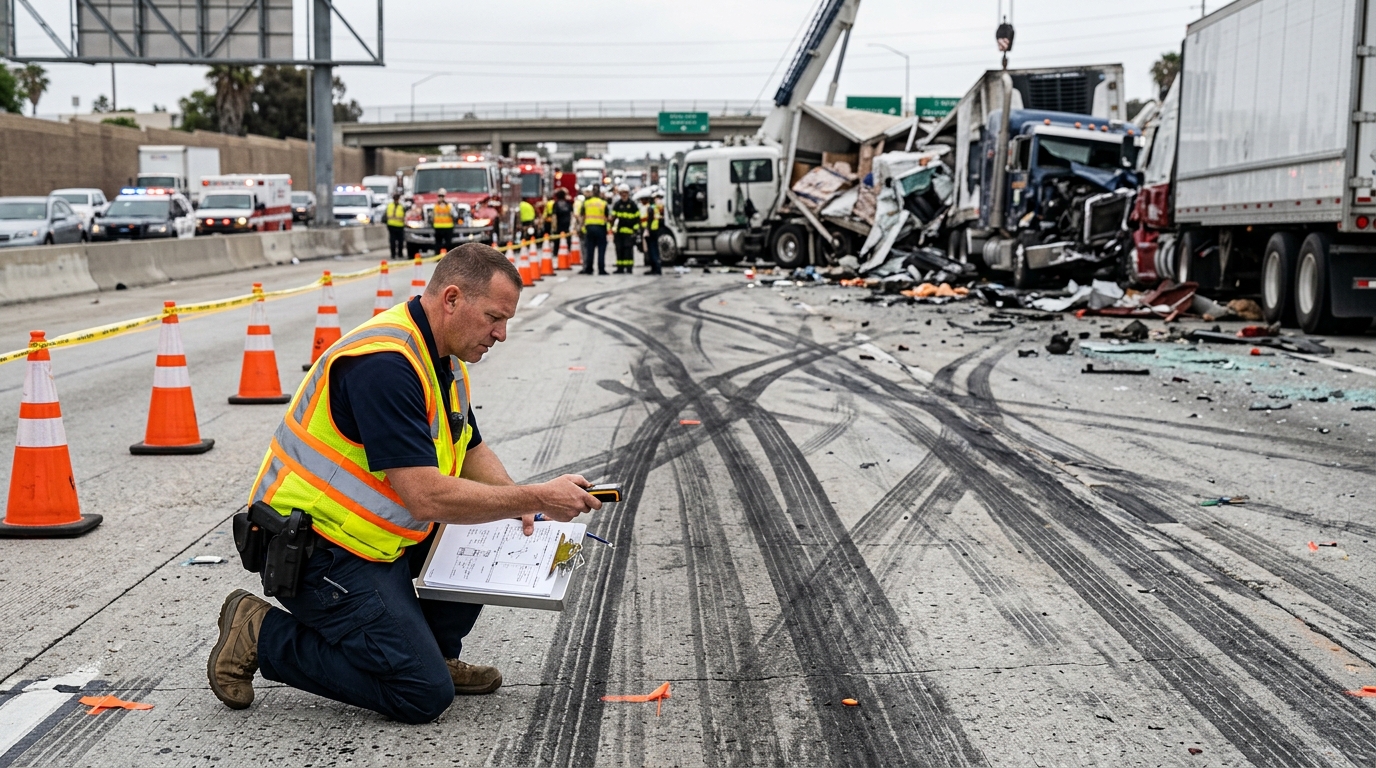
One truck can start a multi-vehicle crash in several ways. A truck driver may fail to slow down for stopped traffic. A driver may change lanes without enough space. A truck may jackknife after braking too hard. A load may shift and make the trailer unstable. A mechanical failure may cause the truck to drift into another lane. A distracted or fatigued driver may miss warning signs until it is too late.
In some cases, the truck does not even hit every injured person directly. The truck may hit one vehicle, which then hits another. Or the truck may spill cargo, causing several vehicles to brake and collide. That does not automatically remove the trucking company from responsibility. If the truck driver or carrier started the dangerous sequence, they may still be a major focus of the claim.
Your related article on how to prove fault in a truck accident in Orange County is a strong internal link here because chain-reaction cases depend on clear evidence, not assumptions.
Rear-End Traffic Queue Crashes
One common chain-reaction pattern happens when a truck approaches slow or stopped traffic too fast. Orange County freeways often shift from moving traffic to sudden backup near interchanges, lane closures, crash scenes, and construction areas. A truck driver who is distracted, fatigued, following too closely, or driving too fast may not stop in time.
When a large truck strikes the back of a passenger vehicle, that vehicle can be shoved into the next car. The impact can continue through several vehicles. In these cases, investigators may review speed data, braking evidence, dashcam video, electronic logging device data, traffic camera footage, and witness statements to identify the first harmful impact.
Lane-Change and Merge-Related Chain Reactions
Another common pattern involves unsafe lane changes or merges. Commercial trucks have large blind spots and need more space than passenger vehicles. If a truck moves into a lane without enough clearance, nearby drivers may brake or swerve. That sudden movement can cause multiple vehicles behind them to collide.
This is especially important near freeway ramps, construction zones, and lane drops. Your article on the role of surveillance cameras in truck accident investigations fits naturally here because cameras from businesses, traffic systems, dashcams, and nearby vehicles may show how the chain reaction began.
Evidence That Can Make or Break a Multi-Vehicle Truck Accident Claim
In a chain-reaction truck crash, every party may have a different story. One driver may say they were pushed forward. Another may say they stopped in time before being hit. The trucking company may claim another vehicle cut off the truck. Because these claims can become messy, evidence must be preserved quickly.
Important evidence may include the police report, photographs, vehicle damage, skid marks, traffic camera footage, dashcam footage, black box data, ELD records, driver qualification records, inspection reports, maintenance records, cargo documents, dispatch messages, and witness statements. The goal is to build a timeline that shows the order of impacts.
Federal safety rules also matter because motor carriers must keep accident registers for qualifying crashes. The FMCSA accident recordkeeping guidance explains that motor carriers must maintain a crash register for crashes that meet the regulatory definition. This type of documentation can become relevant when investigating a commercial truck company’s safety history.
Building the Timeline of the Crash
The timeline is one of the most important parts of a chain-reaction truck accident claim. It helps answer key questions: Which vehicle made the first impact? Was traffic already stopped? Did the truck brake before the collision? Did cargo spill before or after impact? Another driver contribute to the crash? Was the truck moving too fast for traffic conditions?
Investigators may compare physical evidence with electronic records. For example, vehicle damage can show direction of impact. Dashcam footage can show lane position. ELD data can show driving hours. Engine control data may show speed and braking. Cell phone records may be reviewed if distraction is suspected. Inspection reports may reveal whether mechanical problems contributed to the crash.
Your article on the role of truck inspection reports in truck accident cases is useful because inspection failures may explain why a truck could not stop, steer, or remain stable during the crash sequence.
Medical Records and Injury Timing Matter

Medical records are also important in multi-vehicle crashes. A victim may be hit more than once, making injuries harder to trace. Neck injuries, back injuries, concussions, shoulder injuries, knee injuries, fractures, and internal injuries may not be fully understood at the crash scene.
Victims should seek medical attention as soon as possible and explain every impact they remember. If symptoms get worse later, follow-up care should be documented. Insurance companies may try to argue that an injury came from another impact, an old condition, or a later event. Clear medical records help connect the injuries to the chain-reaction crash.
Who Can Be Liable After a Chain-Reaction Truck Crash?
Liability may involve more than one party. The truck driver may be responsible if they were speeding, distracted, fatigued, following too closely, changing lanes unsafely, or failing to react to traffic. The trucking company may be responsible if it failed to train the driver, ignored hours-of-service problems, skipped maintenance, pressured unsafe schedules, or hired an unsafe driver.
Other parties may also be reviewed. A cargo loader may be responsible if shifting cargo contributed to the crash. A maintenance company may be liable if brake, tire, or steering issues were missed. Another driver may share responsibility if they made an unsafe maneuver. A vehicle or parts manufacturer may be investigated if a defect contributed to the collision.
Your internal article on understanding liability in truck accident cases fits this section because multi-vehicle truck crashes often involve several possible defendants and insurance policies.
Why Insurance Companies May Fight Harder in Multi-Vehicle Claims
Insurance companies often fight harder when many vehicles and injury victims are involved. Each insurer may try to shift blame to another driver. A trucking insurer may argue that the truck was reacting to traffic instead of causing the crash. Another insurer may argue that later impacts caused the worst injuries. This can delay settlement and make the claim more stressful for victims.
Victims should avoid guessing about fault in recorded statements. It is better to focus on facts: where your vehicle was, what you saw, what you felt, and what happened after impact. Your guide on what to do if you are injured in a truck accident while driving in Orange County can help victims understand early steps after a crash.
Chain-reaction truck crashes in Southern California require fast evidence preservation and careful investigation. The first police report may not capture every detail, and the most important proof may come from video, electronic truck data, inspection records, maintenance history, cargo documents, and witness accounts. When a commercial truck starts or contributes to a multi-vehicle crash, victims should not accept a quick blame-shifting explanation before the full evidence is reviewed.