
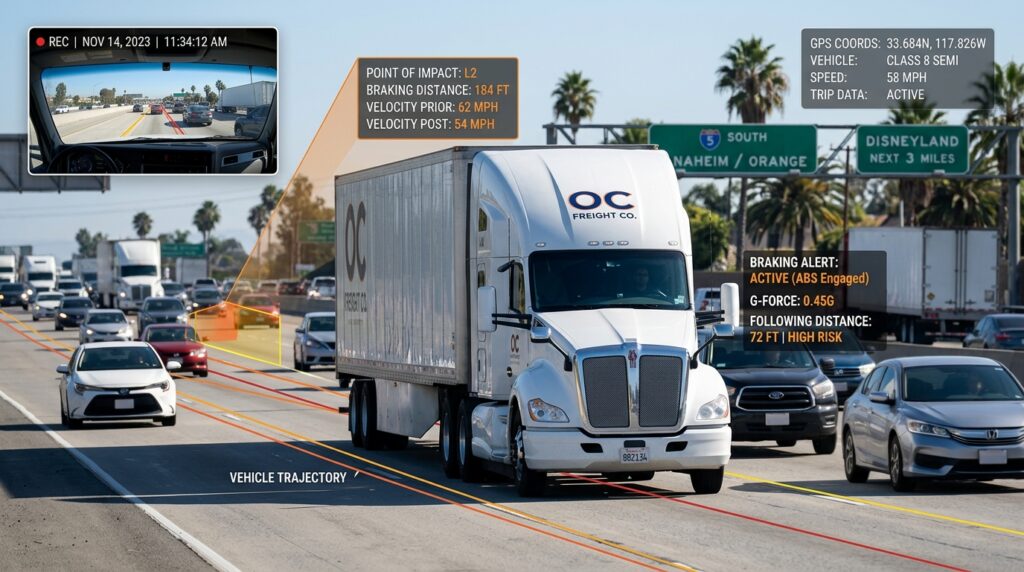
AI dashcam truck accident evidence is becoming one of the most important tools in modern Orange County truck accident claims. Commercial trucks, delivery vehicles, box trucks, and tractor-trailers now often carry advanced camera systems that do more than record the road. Many systems can capture speed, braking, GPS location, following distance, lane movement, driver distraction alerts, and unsafe driving events.
That matters because truck accident cases are rarely simple. A serious collision may involve a truck driver, trucking company, maintenance provider, broker, cargo loader, vehicle owner, or another motorist. Without strong evidence, the insurance company may try to reduce the crash to a basic story: traffic stopped suddenly, the victim changed lanes, or the driver made an unavoidable mistake. Video telematics can challenge that version of events.
In Orange County, this issue is especially relevant because commercial vehicles move through busy freeway corridors, including I-5, I-405, SR-55, SR-57, SR-91, and local delivery routes near warehouses, shopping centers, ports, and construction areas. A truck driver has to manage congestion, changing speeds, tight merges, blind spots, and constant delivery pressure. When something goes wrong, AI dashcam truck accident evidence may show what happened before the impact, not just the damage afterward.
This article explains how AI dashcams and video telematics may affect truck accident claims, what evidence victims should try to preserve, and why early investigation can make a major difference.
Why AI Dashcam Truck Accident Evidence Matters After a Serious Crash
Traditional dashcams usually record video from the front of a vehicle. Modern AI-powered fleet camera systems can go further. Some may include road-facing cameras, driver-facing cameras, GPS tracking, event-triggered clips, hard-braking alerts, lane departure warnings, speed data, and cloud-based storage. Depending on the system, the camera may flag risky driving behavior before, during, and after the crash.
That type of evidence can be powerful because it gives investigators a more complete timeline. A police report may document the crash location, vehicle positions, statements, and citations. But it may not show whether the truck was following too closely ten seconds before impact, whether the driver looked down, whether the vehicle drifted between lanes, or whether the truck failed to slow when traffic ahead was already braking.
How video telematics can reveal the crash timeline
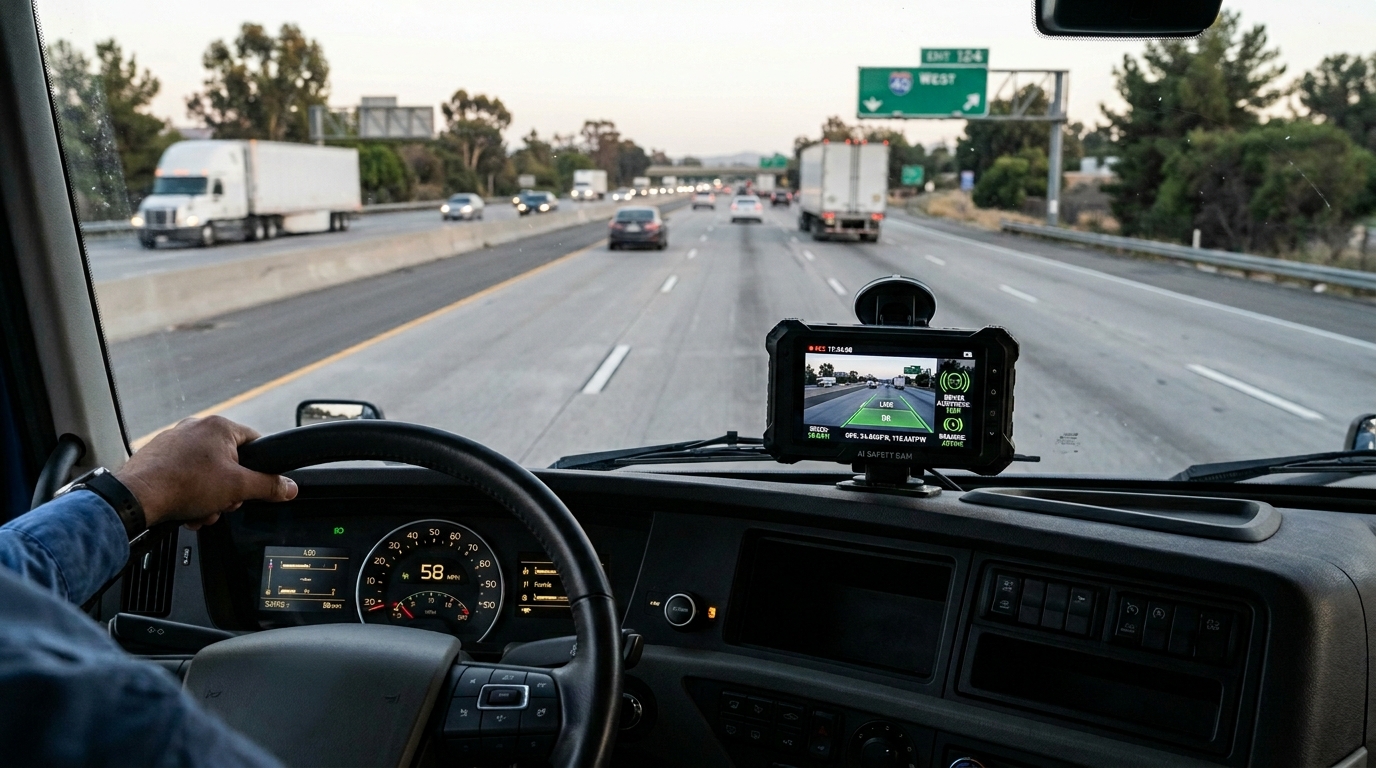
Video telematics can help answer questions that are difficult to prove with photos alone. Did the truck driver have enough time to stop? Was traffic already slowing? Did the driver react late? Was the truck speeding for the road conditions? Did the driver make an unsafe lane change? Did the truck follow too closely before the crash?
When the footage is clear and properly preserved, it can help establish the sequence of events. It may show brake lights ahead, road construction, poor visibility, traffic congestion, weather conditions, lane markings, and the actions of nearby vehicles. It can also show whether the truck driver appeared distracted, fatigued, or inattentive.
This is where surveillance camera evidence in truck accident investigations connects naturally with AI dashcam technology. A strong case may combine truck dashcam footage, traffic cameras, nearby business cameras, witness videos, and accident reconstruction evidence.
Road-facing footage can support or challenge driver statements
Road-facing footage may confirm what the truck driver says, but it can also expose problems in the driver’s version of events. For example, a driver may claim that another vehicle suddenly cut in front of the truck. The video may show that the other vehicle had already been in the lane for several seconds. A driver may claim traffic stopped without warning. The footage may show brake lights ahead, slow traffic, or a long line of vehicles before impact.
This type of evidence can be especially useful in rear-end crashes, lane-change crashes, merging collisions, jackknife events, and intersection accidents. The camera may not answer every legal question, but it can narrow the dispute and force the insurance company to deal with the actual timeline.
Driver-facing footage may reveal distraction or fatigue
Some fleet camera systems include driver-facing video. This can become important if distraction or fatigue is suspected. The footage may show the driver looking down, reaching for something, using a phone, eating, adjusting equipment, or failing to scan traffic. It may also show signs of fatigue, such as repeated yawning, slow reactions, lane drift, or delayed braking.
Driver-facing footage can be sensitive because it involves privacy and employment issues. However, in a serious injury claim, it may become relevant if it shows conduct that contributed to the collision. A victim does not need to guess whether the driver was distracted if the video, ELD records, and crash pattern all point in the same direction.
Why AI alerts should not be accepted blindly
AI dashcam alerts can be useful, but they should not be treated as perfect. An alert may flag hard braking, close following, lane departure, phone use, or distraction. Still, the underlying video and data need to be reviewed carefully. The system may misread an event, miss context, or fail to capture something outside the camera angle.
That is why attorneys and investigators often look at the entire evidence package. They may compare dashcam clips with ELD records, GPS data, inspection reports, dispatch messages, police reports, witness statements, vehicle damage, and medical records. The strongest cases are not built on one alert. They are built on matching evidence that tells the same story.
For official background on electronic logging devices, readers can review the Federal Motor Carrier Safety Administration’s ELD information. ELDs are different from AI dashcams, but both can help show how a commercial vehicle was being operated before a crash.
AI evidence must be preserved before it disappears
One of the biggest problems with AI dashcam truck accident evidence is timing. Some systems upload event clips to the cloud. Others overwrite video after a short period. Some store only triggered clips, not continuous footage. A trucking company may control the system, the vendor may control the cloud platform, and the driver may not have direct access to the evidence.
That means victims should act quickly after a serious Orange County truck crash. A preservation letter may be needed to demand that the trucking company, fleet owner, insurer, and technology vendor preserve dashcam footage, telematics records, GPS data, ELD records, driver-facing video, event reports, inspection records, and dispatch messages. Waiting too long can allow important footage to be overwritten or “lost.”
This also connects with your related article on ELD truck accident evidence in Orange County. In many claims, the dashcam video shows what happened visually, while ELD and GPS records help confirm the timing, route, movement, and driver activity.
How AI Dashcam Evidence Can Strengthen an Orange County Truck Accident Claim
Truck accident claims are evidence-driven. Serious injuries may include traumatic brain injuries, spinal injuries, fractures, internal injuries, nerve damage, shoulder injuries, knee injuries, burns, or long-term mobility problems. The value of the claim can depend on proving both liability and damages. AI dashcam footage can help with liability, but it must be connected to the broader claim.
For example, video may show a truck driver following too closely before a freeway crash. That can support negligence. But the victim still needs medical records, imaging results, treatment notes, wage loss documentation, and proof of future care needs. Evidence of fault and evidence of damages work together.
What records should be requested after a truck crash
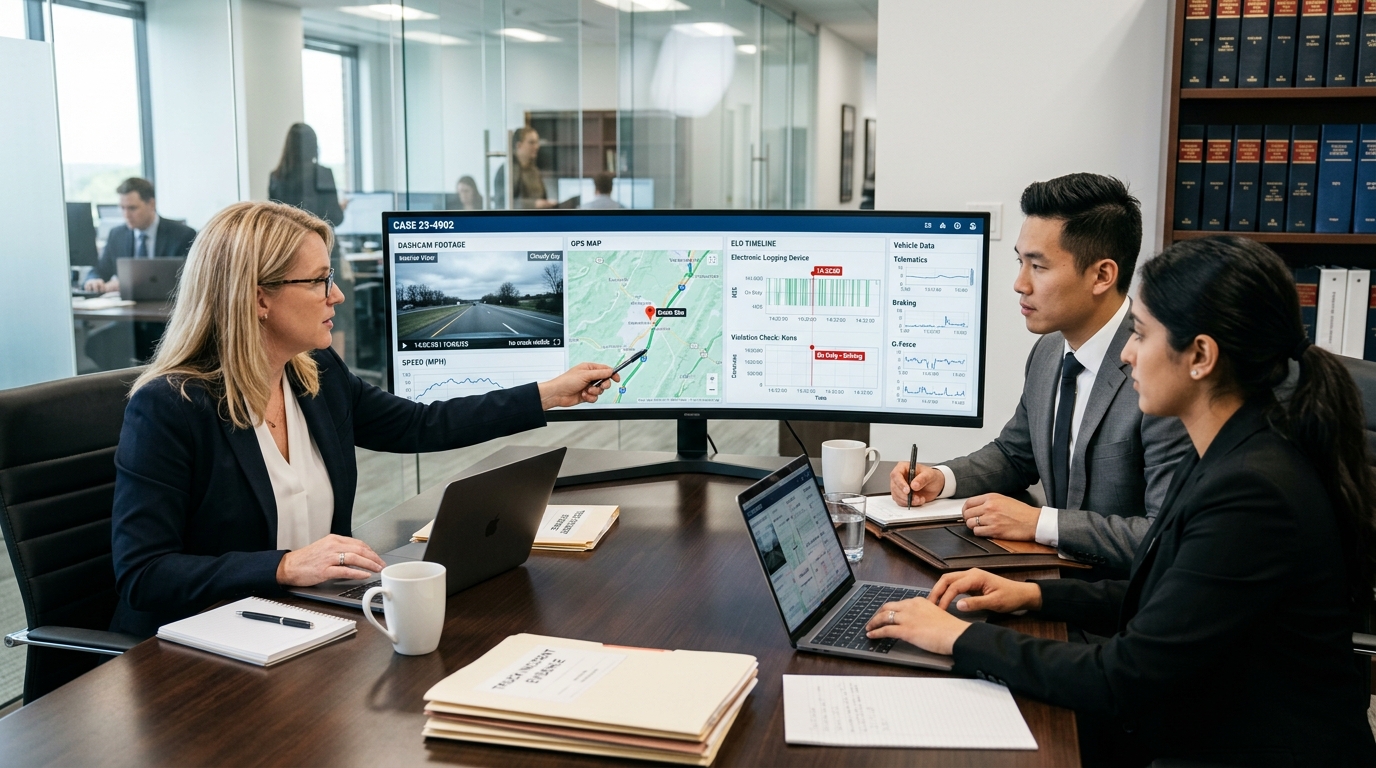
After a serious truck accident, useful records may include road-facing dashcam footage, driver-facing footage, AI event reports, GPS tracking, ELD logs, hours-of-service records, dispatch messages, bills of lading, driver qualification files, inspection reports, maintenance records, repair history, onboard vehicle data, cell phone records, and insurance communications.
A crash involving fatigue may also require HOS and dispatch review. Your article on truck driver fatigue accident claims in Orange County is a strong internal link because AI dashcam clips may show late reactions while HOS and ELD records may explain why the driver was tired in the first place.
Liability may also extend beyond the driver. A trucking company may be responsible if it ignored unsafe driving alerts, failed to coach the driver, kept a dangerous driver on the road, pushed unrealistic schedules, failed to maintain the vehicle, or allowed repeated safety violations. Your article on who may be liable in a truck accident case supports this issue because commercial vehicle claims often involve several responsible parties.
AI dashcam footage can expose company-level negligence
One overlooked benefit of AI dashcam data is that it may reveal patterns, not just one crash. If a driver had repeated close-following alerts, hard-braking events, distraction warnings, or lane-departure incidents before the collision, the trucking company may have had notice of unsafe behavior. If the company failed to act, that may support negligent supervision, negligent retention, or poor safety management arguments.
This is important because insurance companies often try to keep the focus on one driver’s split-second decision. But a preventable truck crash may be the result of repeated ignored warnings. If the company had safety data and failed to use it, the claim may become much stronger.
Victims should also be careful with insurance adjusters. An adjuster may ask for a recorded statement before all evidence is available. The victim may not know that a dashcam clip, AI event report, or GPS record contradicts the trucking company’s version. Giving a casual statement too early can create unnecessary problems. It is better to focus on medical care, evidence preservation, and avoiding speculation.
AI dashcam truck accident evidence can be a turning point in Orange County truck accident claims because it may show the moments that matter most: what the truck driver saw, how the truck moved, when braking began, whether the driver reacted late, and whether the company had warning signs before the crash. But the evidence must be preserved quickly, reviewed carefully, and compared with other records.
General information only. This article is for educational purposes and is not legal advice. Truck accident laws, evidence rules, deadlines, and insurance procedures vary by case. Speak with a licensed attorney about a specific Orange County truck accident claim.