
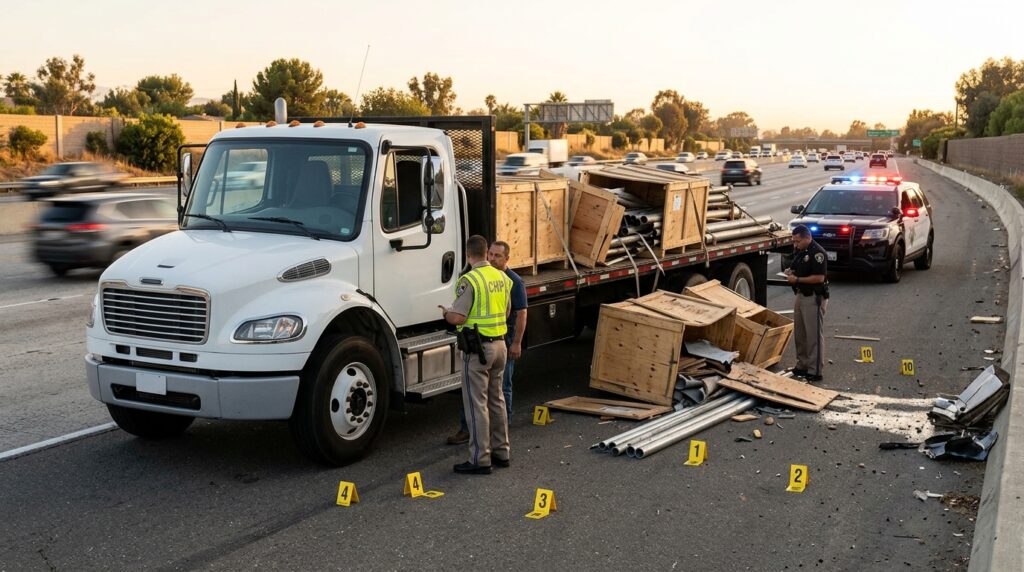
Cargo securement failure truck accidents can cause devastating crashes in Orange County because a commercial vehicle does not need to collide directly with another driver to create danger. A shifting load can make a truck roll over. Falling cargo can strike a vehicle behind it. Spilled materials can block lanes, trigger chain-reaction collisions, or force drivers to swerve into traffic.
These accidents often involve more than a careless driver. A loading company, trucking company, shipper, freight broker, maintenance provider, or cargo securement crew may have contributed to the crash. When a load shifts, spills, or falls, the case may turn on records that most victims never see unless someone demands them early.
In Orange County, this issue matters because commercial trucks travel through busy routes connected to freeways, warehouses, ports, construction sites, and distribution centers. A poorly secured load on I-5, I-405, SR-55, SR-57, or SR-91 can create a serious hazard within seconds.
Why Cargo Securement Failure Truck Accidents Are So Dangerous
Commercial trucks carry heavy, uneven, oversized, or unstable cargo. Some trucks haul construction materials, machinery, lumber, pipes, pallets, containers, vehicles, gravel, landscaping materials, or industrial equipment. If the cargo moves during transit, the driver may lose control before anyone nearby understands what happened.
The Federal Motor Carrier Safety Administration explains that cargo securement rules aim to reduce accidents caused by cargo shifting on or within, or falling from, commercial motor vehicles. Readers can review the official FMCSA cargo securement rules for background on these safety requirements.
The danger becomes worse when traffic moves fast or lanes are crowded. A small object can crack a windshield. A heavy object can crush a vehicle. Loose cargo can also create road debris that causes a crash long after the truck has left the scene.
Load shifts can cause rollovers and jackknife crashes
A truck’s weight distribution affects how it handles. If cargo shifts during a turn, lane change, hard brake, or downhill movement, the vehicle can become unstable. The driver may overcorrect, lose steering control, or roll the truck onto its side.
Rollovers and jackknife crashes can block multiple lanes and involve several vehicles. In some cases, the cargo remains inside the trailer but still changes the truck’s balance enough to cause a collision. That is why investigators should examine both the outside crash damage and the condition of the load inside the trailer.
Falling cargo can injure people who never hit the truck
Falling cargo creates a different kind of danger. A driver behind the truck may hit the object, swerve to avoid it, or get struck directly. The victim may not even know which truck lost the load, especially when the cargo falls at night or in heavy traffic.
This is where early evidence becomes critical. Dashcam footage, traffic cameras, business surveillance, witness statements, and debris photos may help identify the truck and connect the fallen cargo to the crash. Your site’s article on surveillance cameras in truck accident investigations supports this point well.
Spilled materials can create chain-reaction collisions
Some cargo does not fall as one object. It spills. Gravel, dirt, liquids, scrap metal, produce, boxes, or broken pallets can scatter across lanes and create several crash risks at once.
A driver may brake suddenly after seeing debris. Another vehicle may hydroplane, skid, or lose traction. Motorcyclists face even greater danger because loose material can cause a loss of control quickly. In these cases, the first crash may not show the full scope of harm.
Securement rules can help prove what went wrong
Cargo securement failure truck accidents often require a close look at federal rules, company policies, loading procedures, and inspection practices. Investigators may ask whether the cargo had enough tiedowns, whether the securement devices had adequate strength, whether the load needed chocks or wedges, and whether the driver inspected the cargo before and during the trip.
Federal rules generally require cargo to stay contained, immobilized, or secured so it does not leak, spill, blow, fall, or shift enough to affect vehicle stability or maneuverability. When a crash involves falling or shifting cargo, those standards can help frame the liability investigation.
A violation does not automatically explain every injury, but it can support the argument that someone failed to follow basic safety practices. The stronger claim connects the rule, the unsafe act, the crash sequence, and the victim’s injuries.
Inspection reports can expose ignored warning signs
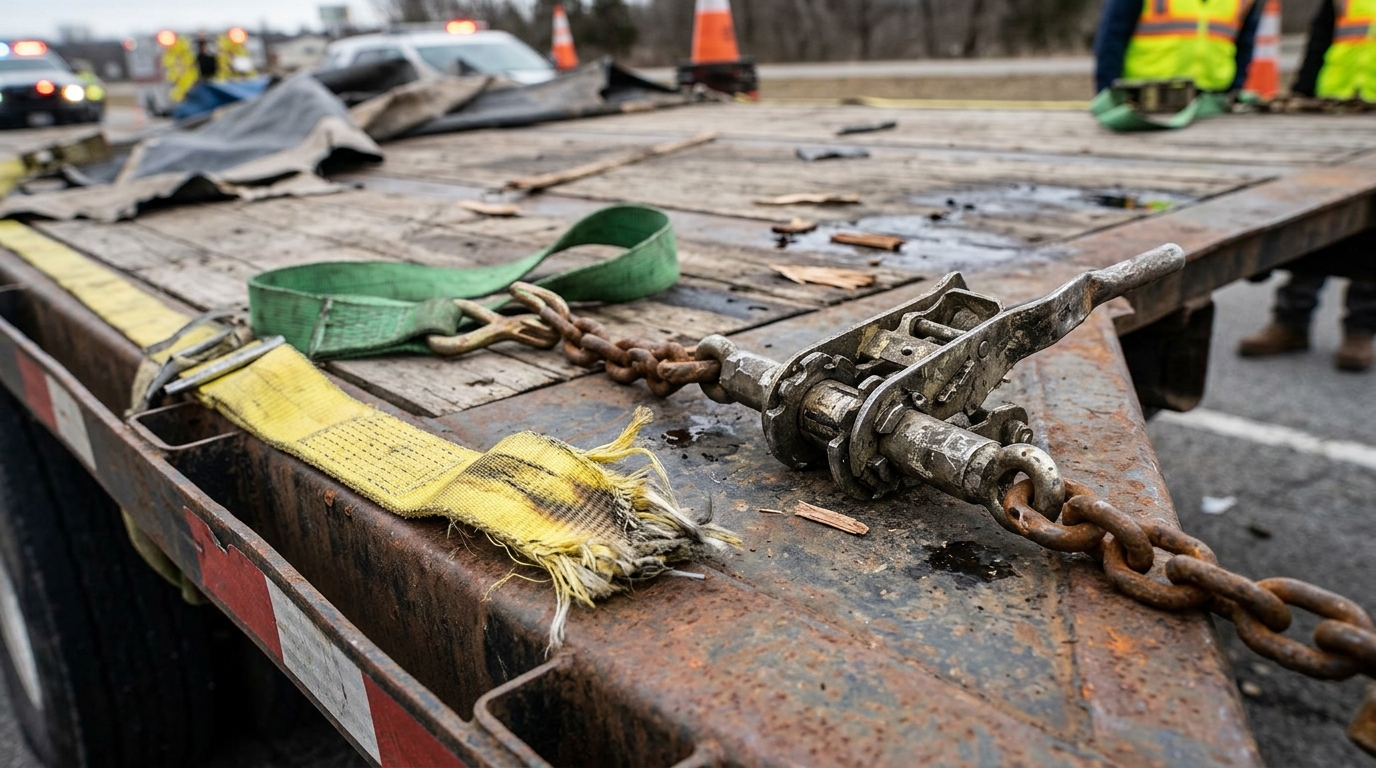
Inspection evidence may show whether the truck, trailer, tiedowns, chains, straps, binders, anchor points, doors, tarps, or load bars had problems before the crash. Worn straps, damaged chains, weak anchor points, loose doors, broken pallets, or overloaded trailers can all matter.
Victims should not rely only on the trucking company’s version of the inspection. Supporting records may include driver vehicle inspection reports, roadside inspection results, maintenance files, loading photos, repair invoices, and post-crash photographs. For related reading, use your article on how to prove fault in a truck accident in Orange County.
Who May Be Liable After a Cargo Securement Failure Crash
Liability may extend beyond the truck driver. The driver may have failed to inspect the load, ignored movement, drove too fast for the cargo, or continued after noticing instability. The trucking company may have failed to train drivers, supervise routes, maintain securement equipment, or enforce safety policies.
The shipper or loading crew may also face questions. They may have loaded cargo unevenly, used the wrong securement method, exceeded weight limits, failed to block rolling materials, or ignored known risks. A maintenance provider may matter if defective equipment contributed to the failure.
Because several parties may share responsibility, victims should avoid accepting a quick explanation. A company may try to blame only the driver, while the full record points to unsafe loading, poor training, or weak company oversight.
Important evidence can disappear quickly

Truck accident evidence does not always stay available for long. Companies may repair trailers, replace straps, move cargo, discard broken pallets, overwrite camera footage, or update logs. If the cargo came from a warehouse or construction site, loading area footage may disappear within days.
Key evidence may include bills of lading, weight tickets, loading diagrams, cargo photos, dock records, inspection reports, dispatch messages, ELD data, GPS history, maintenance records, driver training records, and post-crash repair documents. Each record can help answer who handled the cargo and whether they handled it safely.
This topic connects naturally with your site’s article on ELD truck accident evidence in Orange County, because movement history and timing can help explain when the load became unstable.
Medical proof still drives the value of the claim
Strong cargo evidence helps prove fault, but medical evidence proves harm. Victims should get medical care, follow treatment plans, save bills, track symptoms, document missed work, and keep records of physical limits. Truck crashes can cause traumatic brain injuries, spinal injuries, fractures, internal injuries, shoulder injuries, knee injuries, burns, and long-term pain.
Insurance companies may accept that cargo fell or shifted but still dispute the injury claim. They may argue that the crash was minor, the victim had a pre-existing condition, or treatment lasted too long. Medical records, imaging, specialist notes, therapy records, and work restrictions can push back against those arguments.
Cargo securement failure truck accidents can also overlap with negligent hiring, poor driver training, and weak company supervision. If the driver lacked proper training on load checks or securement procedures, your article on negligent truck driver training and Orange County truck claims is a useful internal link. For broader party responsibility, link to understanding liability in truck accident cases.
The main lesson is straightforward: falling or shifting cargo is rarely just bad luck. Someone loaded the truck, secured the cargo, inspected the equipment, planned the route, and decided the vehicle could travel safely. When one of those steps fails, victims deserve a full investigation.
After a serious Orange County cargo-related truck crash, quick action matters. Photograph the scene, preserve debris if possible, identify witnesses, document injuries, avoid rushed insurance statements, and make sure loading records, inspection reports, video footage, and securement equipment receive attention before they disappear.
General information only. This article is for educational purposes and is not legal advice. Laws, evidence rules, insurance procedures, and deadlines vary by case and location. Speak with a licensed attorney about a specific truck accident claim.