
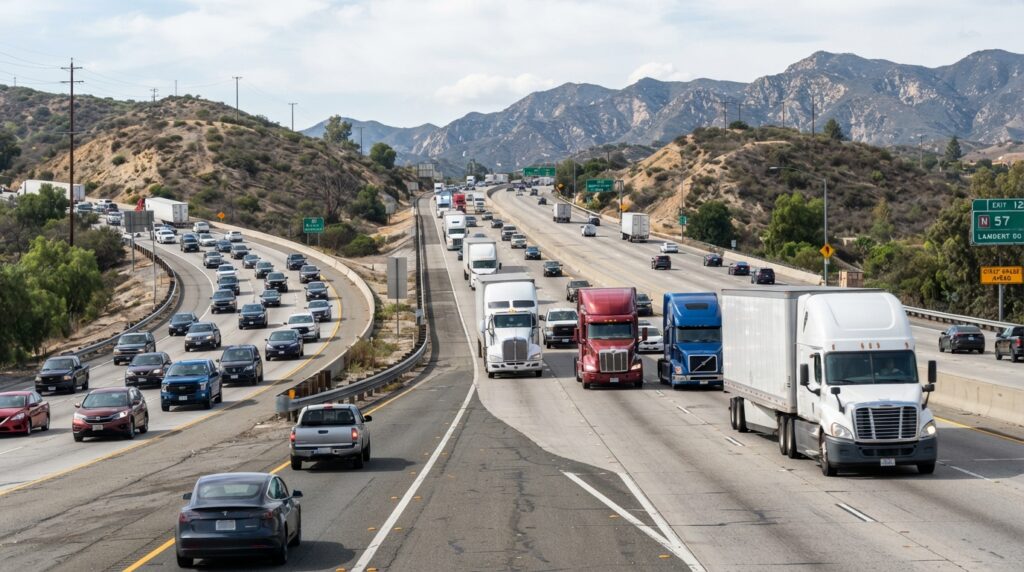
SR-57 truck accidents are getting fresh attention in Orange County as transportation officials study a new truck-only climbing lane on the northbound freeway through Brea.
The California Department of Transportation, working with the Orange County Transportation Authority, is evaluating changes between Lambert Road and the Orange County/Los Angeles County line. The corridor includes sustained uphill grades, significant commercial truck traffic, and a lane drop near the Lambert Road off-ramp.
Those conditions can create large speed differences between heavy trucks and passenger vehicles. They can also make merging more difficult when traffic is congested.
The proposed project does not mean Caltrans has concluded that the existing freeway causes truck crashes. It is a transportation project aimed at improving traffic operations and regional goods movement.
Still, the study highlights several roadway conditions that can also become important evidence after a serious truck collision: grade, traffic speed, merging patterns, lane configuration, visibility, and the behavior of a commercial vehicle before impact.
Why SR-57 Truck Accidents Deserve Attention in 2026
State Route 57 is an important north-south route connecting Orange County with Los Angeles County and other Southern California freight corridors.
Commercial trucks use the freeway to move goods between warehouses, distribution centers, ports, businesses, and other transportation routes.
Caltrans says trucks account for roughly 8.8% of traffic within the proposed project limits. That percentage becomes important when combined with the sustained climbing grade north of Lambert Road.
Heavy trucks respond differently to steep grades than passenger cars. A fully loaded tractor-trailer may lose speed while climbing even when the driver is operating normally.
That difference can create closing-speed problems for faster vehicles approaching from behind.
Steep Grades Can Create Large Speed Differences
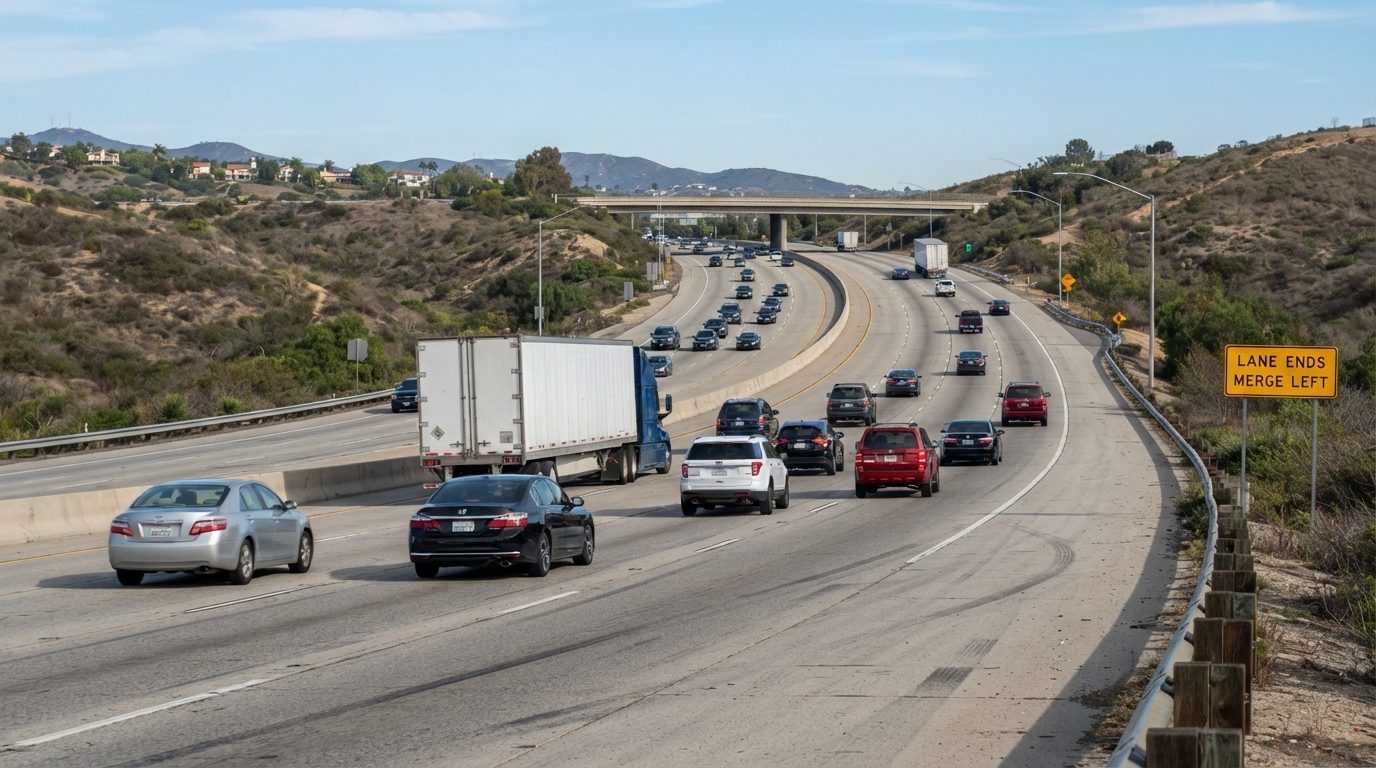
A commercial truck can weigh many times more than a passenger vehicle. Its weight affects acceleration, braking, and how quickly it can regain speed after slowing.
When a truck climbs a sustained grade, its speed may fall while passenger vehicles continue moving faster around it.
That does not automatically mean the truck driver is negligent.
However, large speed differences can increase the importance of safe following distances, mirror checks, lane positioning, turn signals, and defensive driving.
Passenger drivers also have responsibilities. Cutting closely in front of a heavy truck or making an abrupt lane change can leave a truck driver with very little braking distance.
After a serious collision, investigators need to reconstruct what each vehicle was doing rather than assuming that the largest vehicle caused the accident.
The Lambert Road Lane Drop Can Add Merging Pressure
One reason Caltrans and OCTA are studying the corridor is the existing northbound lane drop near the Lambert Road off-ramp.
A lane drop forces traffic streams to reorganize. Drivers may need to merge while also dealing with slower commercial vehicles climbing the grade.
In heavy traffic, that can produce sudden braking, short following distances, and last-second lane changes.
The proposed project would extend the outside general-purpose lane beyond the existing drop and convert that extended section into a truck-only climbing lane under the build alternatives being studied.
One alternative would extend the truck lane from Lambert Road to just south of Tonner Canyon Road. Another would continue it to the Orange County/Los Angeles County line.
The project remains in the environmental and engineering review stage. No final build alternative has been selected.
A Proposed Safety Improvement Does Not Automatically Prove Roadway Liability
A future transportation project should not be treated as automatic proof that an existing freeway was negligently designed or maintained.
Agencies study roadway improvements for many reasons, including future traffic growth, congestion, goods movement, operational efficiency, and changing transportation demand.
Likewise, the existence of a proposed truck lane does not establish that a roadway condition caused a particular crash.
A real accident investigation needs evidence from that specific collision.
Investigators may review vehicle positions, lane markings, traffic flow, speed, road geometry, truck loading, driver behavior, mechanical condition, weather, and electronic data.
Our guide to proving fault in an Orange County truck accident explains why commercial vehicle claims often involve several sources of evidence rather than one simple assumption.
Truck Data Can Show What Happened Before Impact
Modern commercial vehicles can produce valuable digital evidence.
Electronic logging devices may document driving time and duty status. Engine control modules may contain information about speed or vehicle operation. Telematics platforms can track location, braking events, acceleration, and other fleet activity.
Some carriers also use forward-facing or driver-facing cameras.
When a crash occurs near a steep grade or merge point, these records may help establish whether the truck was already moving slowly, whether braking occurred, and how quickly conditions changed.
They can also help separate normal grade-related slowing from other issues such as mechanical failure, distraction, fatigue, or unsafe driving.
Inspection and Maintenance Records May Matter Too
Road geometry is only one possible part of a truck collision.
A mechanical problem can make a difficult traffic situation much worse. Brake defects, worn tires, lighting problems, steering issues, or other maintenance failures can reduce a driver’s ability to respond safely.
Federal and state commercial vehicle rules require inspections and maintenance, but the relevant records must still be examined in an individual case.
Maintenance files can show when components were inspected, what problems were reported, and whether repairs were completed.
The site’s article on truck inspection reports in accident cases explains how inspection history can become relevant when mechanical condition is disputed.
What to Preserve After an SR-57 Truck Crash
Medical care comes first after any serious commercial truck collision.
Large-truck crashes can cause head injuries, spinal injuries, fractures, internal trauma, burns, and other serious harm. Some symptoms may also become more noticeable after the initial shock of the accident fades.
After immediate medical needs are addressed, preserve evidence as quickly as practical.
Freeway scenes change fast. Vehicles are removed. Debris disappears. Traffic resumes. Electronic records may also be overwritten if no one takes steps to preserve them.
Document the Road, Truck, Traffic, and Digital Evidence
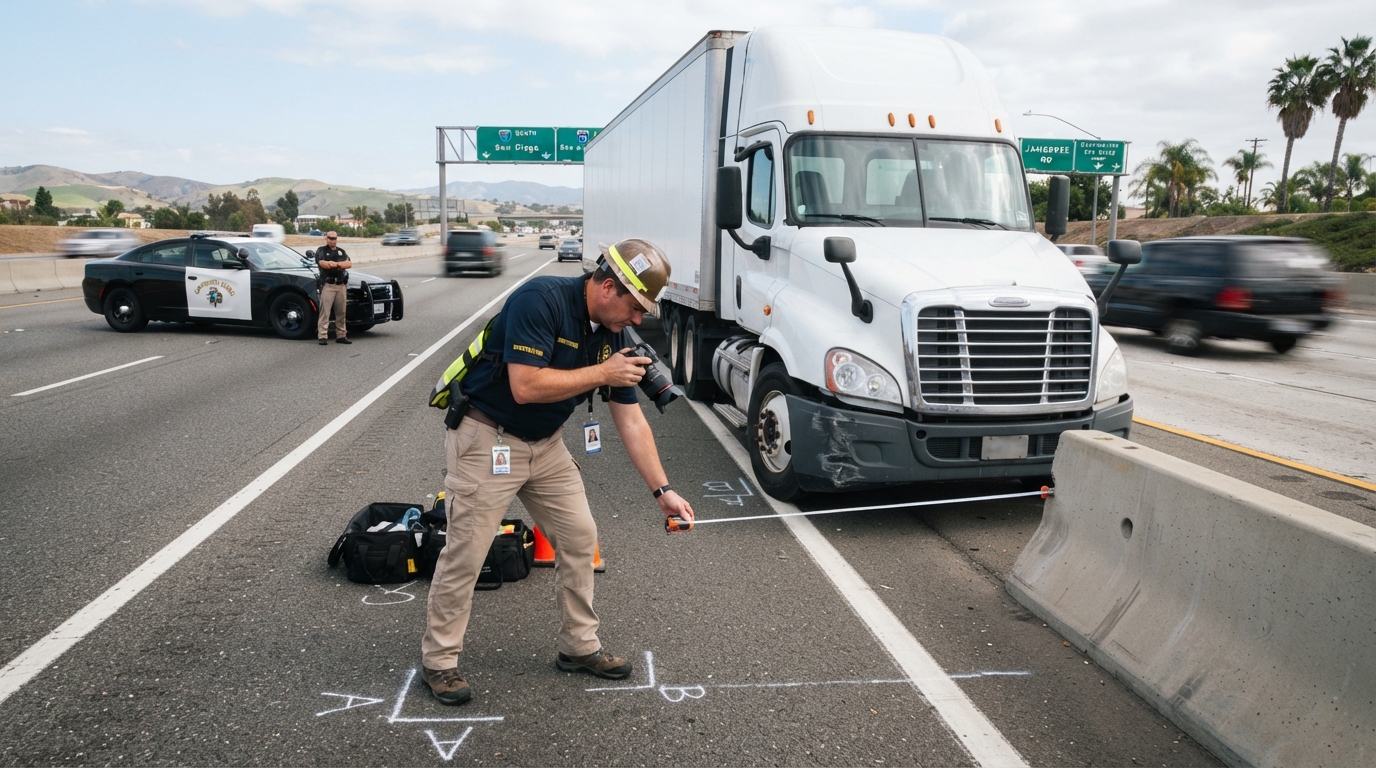
Photos can help establish the conditions that existed at the time of the crash.
When it is safe to do so, document vehicle damage, lane markings, merge areas, nearby exits, skid marks, debris, construction signs, visibility, and the surrounding roadway.
Record the truck’s company name, USDOT number when visible, license plate, trailer information, and other identifying details.
Witnesses can be especially valuable on a busy freeway. Another driver may have seen the truck change lanes, slow suddenly, experience a tire problem, or approach traffic before the collision.
Nearby vehicles may also contain dashcam footage.
Commercial carrier records should be preserved promptly when they may matter. Relevant materials can include driver qualification files, dispatch communications, hours-of-service records, ELD data, maintenance history, inspection reports, telematics, onboard video, and cargo information.
Current SR-57 Project Records Can Provide Context, Not Automatic Fault
The 2026 SR-57 Truck Climbing Lane Project also creates a public record about the corridor itself.
Caltrans and OCTA describe steep sustained grades, heavy truck volumes, the Lambert Road lane drop, speed differences, difficult merges, congestion, and unreliable travel times as operational issues within the study area.
Those documents may provide useful background about roadway conditions.
However, they should not be substituted for crash-specific evidence.
A collision might result from driver fatigue, an unsafe lane change, speeding, distracted driving, poor maintenance, cargo problems, passenger-vehicle behavior, or several contributing factors.
California’s comparative negligence rules can also allow responsibility to be divided when more than one party contributed to an accident.
The most reliable investigation looks at the complete picture.
If you were involved in a commercial vehicle crash, the site’s guide on what to do after an Orange County truck accident covers medical care, scene documentation, witnesses, insurance, and other immediate steps.
project
The proposed SR-57 project is still in its early stages. Caltrans and OCTA are evaluating a No Build Alternative and two alternatives involving truck climbing lanes.
Public scoping began September 14, 2026, and comments are being accepted through October 16, 2026. A draft environmental document is currently anticipated in early 2028, followed by a final environmental document later in 2028.
That timeline means Orange County drivers should not expect a new truck-only lane immediately.
For now, the corridor continues to operate with the existing grade, truck traffic, and lane configuration.
The project nevertheless offers a useful reminder about SR-57 truck accidents: a serious commercial vehicle crash may involve more than the final seconds before impact.
Road geometry matters. Truck weight matters. Speed differences matter. Maintenance, driver behavior, traffic conditions, and electronic records can matter too.
When those factors are examined together, investigators can build a more accurate picture of how the collision occurred.
For current maps, project alternatives, public-comment information, and the official project description, visit the Caltrans SR-57 Truck Climbing Lane Project page.
This article provides general educational information and does not constitute legal advice. Roadway liability, negligence, commercial carrier responsibility, comparative fault, insurance coverage, and filing deadlines depend on the specific facts and applicable law.