
Truck accident cases are rarely simple. A serious collision involving a commercial vehicle can raise questions about driver fatigue, distracted driving, maintenance failures, cargo problems, and company-level negligence. In 2026, another issue has become more important in certain cases: truck driver English proficiency.
This does not mean every crash involving a language issue automatically creates liability. It also does not mean a person’s accent or background has anything to do with fault. What matters is whether the driver met the legal qualification standard required to operate a commercial motor vehicle safely in the United States and whether a failure in that area contributed to the crash, the inspection process, or the employer’s hiring decisions.
The Federal Motor Carrier Safety Administration requires commercial drivers to be able to read and speak English sufficiently to converse with the public, understand highway traffic signs and signals, respond to official questions, and make entries on reports and records. In May 2025, FMCSA announced stronger enforcement of that longstanding requirement, and in early 2026 the agency issued additional FAQs explaining how the enforcement policy works. That makes this a timely legal issue for victims and families trying to understand whether a truck driver qualification failure may have played a role in an Orange County crash.
If your site visitors are already reading about deeper qualification problems, this article should connect naturally to How Negligent Truck Driver Training Can Affect an Orange County Truck Accident Claim in 2026, because both topics deal with what should have happened before the truck ever hit the road.
Why Truck Driver English Proficiency Matters in a Truck Accident Case
A commercial truck driver does not just steer a large vehicle. The job also requires reading road signs, understanding route restrictions, responding during roadside inspections, reviewing shipping information, and communicating clearly when safety issues arise. That is why truck driver English proficiency is part of the federal qualification framework rather than a minor technical detail.
In a crash case, this matters when the evidence suggests the driver may have misunderstood signs, failed to respond properly to warnings, struggled during an inspection, or should not have been cleared by the carrier in the first place. It can also matter if the trucking company ignored obvious qualification problems and put the driver on the road anyway.
For injury victims, the bigger point is simple: a crash is not always only about what happened in the final seconds before impact. Sometimes the real negligence started much earlier, during hiring, screening, training, and supervision.
What FMCSA Actually Requires

FMCSA’s rules have long required commercial motor vehicle drivers to meet English-language proficiency standards. In practical terms, that means the driver must be able to communicate sufficiently in English, understand highway traffic signs and signals, respond to official inquiries, and complete necessary records. This is not a brand-new rule. What changed recently was enforcement emphasis.
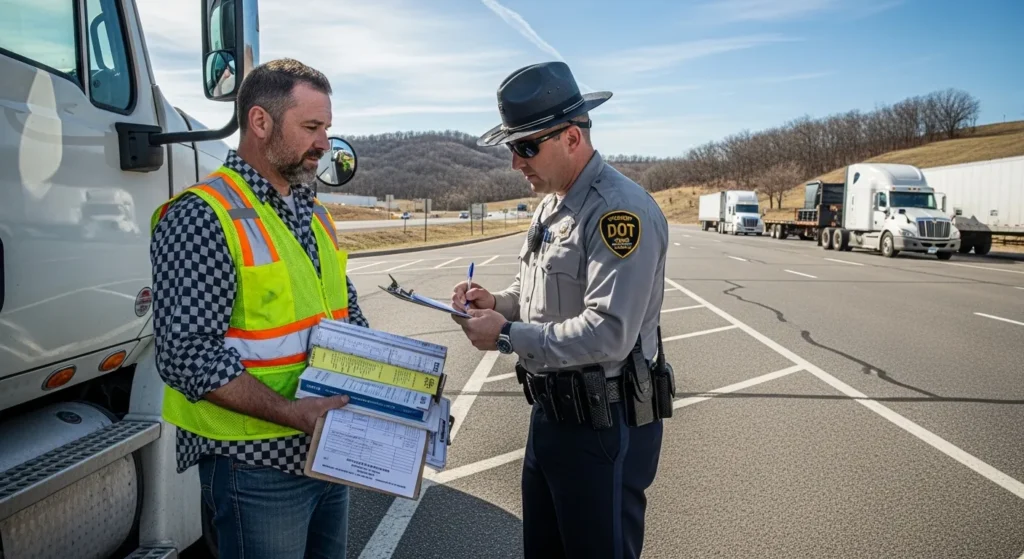
On May 20, 2025, FMCSA announced new guidance stating that drivers who fail to comply with the agency’s longstanding English-language proficiency requirement will be placed out of service. Soon after, FMCSA issued guidance telling motor carriers they should assess this issue during the driver qualification process. That guidance says carriers should evaluate whether the driver can communicate with law enforcement during roadside inspections and understand highway signs they may encounter while driving.
In February 2026, FMCSA issued follow-up FAQs clarifying how the policy is applied, including an exception for certain inspections in border commercial zones along the U.S.-Mexico border. For most claimants in Orange County, the main takeaway is not the exception. It is the fact that the agency is treating English-language qualification as an enforceable safety issue, not just a box to ignore.
When a Truck Driver English Proficiency Problem Can Affect Liability
Not every FMCSA violation proves fault by itself. That is important. A plaintiff still has to connect the evidence to the crash and the resulting harm. But truck driver English proficiency can become highly relevant in several ways.
1. Failure to Understand Traffic Signs or Road Restrictions
If a driver misunderstood posted traffic instructions, lane restrictions, detour information, weight limits, warning signs, or other roadway controls, that can support a negligence argument. In a truck case, a misread sign can have major consequences because commercial vehicles require more space, more stopping distance, and more route awareness than passenger cars.
2. Hiring and Qualification Failures by the Carrier
FMCSA’s 2025 guidance says motor carriers should assess English proficiency during the qualification process. If a company failed to do that, or if records show the driver obviously should not have passed, the carrier may face separate exposure for negligent hiring, retention, or supervision. That broadens the case beyond the driver’s conduct alone.
3. Inspection and Record Problems
Commercial driving involves logs, shipping papers, inspection issues, and roadside communication. If the driver could not reliably answer official questions or understand inspection-related requests, that can become relevant both to qualification and to the company’s safety culture.
4. Credibility and Evidence Issues After the Crash
After a serious collision, what the driver says and understands can matter immediately. Communication difficulties may affect the crash investigation, statements to law enforcement, and later testimony. That does not replace hard evidence, but it can become part of the bigger liability picture.
What Evidence Can Help Show a Qualification Failure?
Like most truck accident cases, this issue is evidence-driven. A victim cannot win just by raising suspicion. The claim needs records, facts, and context.
Useful evidence may include:
- Driver qualification files
- Hiring records and onboarding materials
- Training records and internal assessments
- Roadside inspection reports
- Dispatch communications
- Bodycam, dashcam, or surveillance footage
- Deposition testimony from safety managers or supervisors
- Police reports and witness statements
This is why the topic fits your existing content so well. Readers who want to understand supporting evidence can move naturally to The Role of Truck Inspection Reports in Truck Accident Cases and The Role of Surveillance Cameras in Truck Accident Investigations. In many cases, those records and video sources are what turn a theory into something provable.
Why This Is Not Just About the Driver
One mistake people make is assuming this issue begins and ends with the person behind the wheel. That is too narrow. In many serious truck crash claims, the more important question is what the company knew or should have known before the collision happened.
If a carrier failed to screen the driver correctly, skipped an English-language assessment, ignored red flags, or kept weak qualification records, the company may share responsibility. That matters because trucking companies often have larger insurance policies, stronger control over records, and broader legal duties than the driver alone.
That is also why this article should link to How to Prove Fault in a Truck Accident in Orange County and Understanding Liability in Truck Accident Cases: Who Can Be Held Responsible?. FMCSA qualification failures often matter most because they help identify additional liable parties beyond the driver.
How Insurance Companies May Respond
Insurance carriers are unlikely to hand over value on this issue without a fight. They may argue that the driver’s English skills had nothing to do with the collision. They may say the crash involved a simple lane-change error, following-distance problem, or traffic condition unrelated to qualification. They may also try to frame the issue as irrelevant unless there is direct proof that language limitations caused a specific mistake.
That is why these cases need to be handled carefully. The legal theory should not be overstated, but it also should not be ignored. If the driver should not have been qualified under FMCSA rules, or if the carrier failed to perform the assessment FMCSA says it should conduct, that can strengthen the overall liability story when combined with crash evidence.
What Victims Should Do After a Serious Truck Crash
If you suspect a truck driver qualification issue may be involved, do not try to prove it by guesswork. Focus on the steps that preserve your case:
- Get medical care right away
- Preserve photos, videos, and witness information
- Do not give casual recorded statements to the insurer
- Act quickly so records can be preserved before they disappear
A truck accident lawyer can send preservation letters, request qualification materials, examine inspection records, and investigate whether the company followed FMCSA screening duties. The sooner that happens, the better the chance of protecting evidence.
Final Thoughts
Truck driver English proficiency is not a side issue when the evidence shows it may have affected driver qualification, sign recognition, official communication, or carrier screening. In 2026, this topic matters more because FMCSA has made clear that the requirement is being actively enforced and that motor carriers are expected to assess it during the qualification process.
For Orange County crash victims, that can matter in two ways. First, it may help explain how the collision happened. Second, it may help show that the trucking company failed before the crash ever occurred. In the right case, that can make a major difference in proving fault and pursuing full compensation.
For official background, readers can review FMCSA’s guidance on assessing driver English-language proficiency and FMCSA’s May 2025 enforcement announcement.