
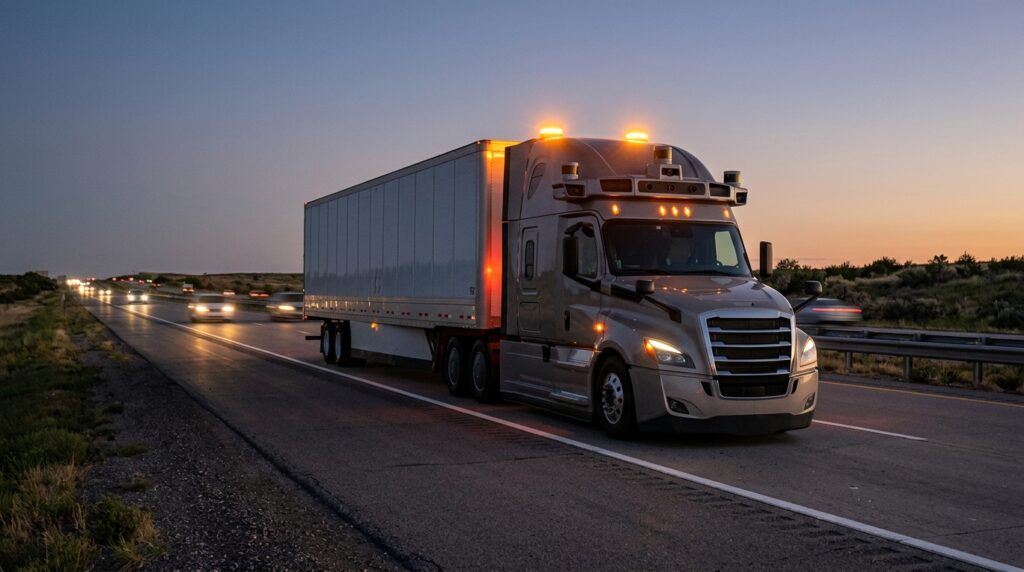
Self-driving truck accident claims in 2026 are entering a new discussion as federal regulators approve an alternative warning system for certain autonomous commercial trucks. On October 7, 2026, the Federal Motor Carrier Safety Administration granted a limited five-year exemption allowing qualifying Level 4 automated trucks to use cab-mounted flashing warning beacons instead of placing traditional warning devices around stopped vehicles.
The decision matters because disabled commercial trucks can present serious roadside hazards. A motorist approaching a stopped tractor-trailer may have limited time to recognize the obstruction, slow down, or change lanes safely.
Traditional federal rules generally require specified warning devices around stopped commercial vehicles in applicable circumstances. However, driverless trucks cannot always rely on a human operator to exit the cab and place reflective triangles.
The new exemption attempts to address that problem through electronically controlled warning equipment.
For Orange County motorists, the announcement raises questions about visibility, automated systems, company responsibility, and the evidence needed after a collision. Although the exemption is national, its potential legal implications are relevant to anyone researching emerging commercial vehicle technology.
What FMCSA’s October 2026 Autonomous Truck Exemption Actually Changes
The FMCSA exemption applies to Aurora Operations and other qualifying motor carriers operating Level 4 automated driving system-equipped commercial motor vehicles. Other carriers must provide prior written notification to FMCSA and satisfy the specified conditions.
Level 4 automation means the automated driving system can perform the driving task within its defined operational design domain. This does not necessarily mean the vehicle can drive everywhere or handle every imaginable road condition.
The exemption permits qualifying trucks to use specified cab-mounted warning beacons instead of the traditional devices covered by the regulatory provisions.
Importantly, this is not a blanket exemption from all federal truck safety requirements. It does not eliminate the carrier’s broader obligations concerning safe operations, equipment, maintenance, or crash reporting.
Why autonomous trucks need a different roadside warning system

When a conventional commercial truck becomes disabled, its driver may need to activate hazard flashers and place warning devices at specified distances, depending on the road and circumstances.
These devices are intended to alert approaching motorists to a stopped commercial vehicle.
A fully driverless truck creates a different operational challenge. Without a person onboard, placing warning triangles beside a busy highway may not be immediately possible.
Cab-mounted beacons offer an alternative that can operate electronically without requiring someone to walk near moving traffic.
FMCSA reviewed the application, supporting research, prior operating experience, and public comments before approving the exemption.
What makes the new warning beacons different?
The approved system uses flashing amber lights mounted in specified positions on the truck cab. The exemption establishes technical requirements for mounting, visibility, light performance, and redundant power.
The warning system must meet stated photometric specifications and operate alongside the vehicle’s required hazard warning signal flashers.
The regulations also address activation and operational restrictions. These requirements matter because a safety system must function reliably under the conditions for which it was approved.
Motorists should not assume every flashing light on a commercial truck qualifies under this exemption. The permission applies only when the specified vehicle, carrier, and equipment requirements are satisfied.
Why the exemption does not apply to every semi-truck
The October decision specifically concerns qualifying Level 4 automated commercial vehicles.
A conventional truck operated by a human driver does not automatically gain permission to replace traditional roadside warning devices with flashing cab lights.
FMCSA also limited the exemption through operational conditions. Trucks must operate within a validated operational design domain rather than treating the exemption as permission for unrestricted deployment.
Certain vehicle configurations and transportation activities are excluded or restricted under the federal notice.
For accident investigations, identifying the exact vehicle and carrier is therefore essential. The presence of automated technology alone does not establish eligibility for the exemption.
What federal regulators considered before approving the exemption
The October decision followed earlier requests and a limited operating waiver. FMCSA cited real-world operating information and research comparing warning beacons with traditional warning devices.
According to the federal notice, Aurora reported operating 34 commercial vehicles for more than 500,000 miles during a temporary waiver period. The beacons were activated for approximately ten hours.
The agency reported that the available operating information did not identify collisions involving the vehicles while stopped and using the beacons during that period.
Nevertheless, these results should not be interpreted as proof that crashes are impossible. The underlying operating experience was limited compared with the range of situations trucks may encounter over many years.
Public comments also raised concerns about visibility on curves, hills, and behind long trailers. FMCSA considered those objections when establishing the exemption’s conditions.
Why warning system reliability matters after a collision
If a collision involves a stopped autonomous truck, investigators may examine whether the warning system was operating correctly.
Potential questions include when the vehicle stopped, whether hazard lights activated, whether the beacons functioned, and whether a technical fault affected visibility.
Roadway geometry also matters. A truck stopped beyond a curve may present different sight-distance challenges than one visible along a straight freeway.
A compliant beacon system does not automatically establish that every operation was safe. Likewise, a collision does not prove that the warning equipment violated federal rules.
Liability depends on the complete evidence and applicable legal standards.
How Self-Driving Truck Accident Claims Could Be Investigated in Orange County
Commercial vehicle claims often involve several potentially responsible parties. With autonomous technology, investigators may also need to understand how the automated driving system made decisions before and after the collision.
California negligence principles generally require evidence of a legal duty, breach, causation, and resulting damages. Other legal theories may apply when a defective product or unsafe equipment contributes to an accident.
The mere involvement of a self-driving truck does not establish negligence by its manufacturer, operator, or software developer.
Instead, investigators must connect specific conduct or a product defect to the injuries suffered.
Who might be responsible after an autonomous truck collision?

The motor carrier may be responsible for aspects of vehicle operation, maintenance, inspection, and compliance with applicable safety requirements.
Depending on the circumstances, investigators may also examine the automated driving technology provider, vehicle manufacturer, maintenance contractor, or other involved parties.
A separate driver may share responsibility if unsafe speed, distraction, or another traffic violation contributed to the impact.
California’s comparative fault principles can affect the allocation of responsibility when more than one party contributes to a collision.
For a broader explanation, read our guide to liability in truck accident cases.
What electronic evidence could reveal about the crash
Automated trucks may generate operational information relevant to an accident investigation. Depending on the system, this could include vehicle speed, braking events, system status, detected objects, or warnings.
However, available data varies by vehicle, software, hardware, and record-retention policies. Investigators should not assume every desired data point exists or will be accessible.
Other valuable evidence may include dashcam footage, maintenance records, inspection reports, roadside photographs, and third-party surveillance videos.
Preserving electronic information promptly can matter because recordings may be overwritten during normal operations.
Our article on FMCSA’s 2026 commercial driver training enforcement explains how operational records and company safety practices can influence truck accident investigations.
The evidence differs between conventional and automated driving, but both situations require careful attention to what the records actually demonstrate.
In a stopped-truck collision, the exact location of the vehicle may become especially important.
Photographs showing the shoulder width, lane position, road curvature, lighting, and nearby signs can help explain what approaching motorists could reasonably see.
Weather and traffic conditions may also affect the analysis. Rain, fog, darkness, or congestion can change stopping distances and available reaction time.
Investigators may need to distinguish a driver’s perception from actual measurable conditions.
If you encounter a stopped commercial truck while driving, reduce speed appropriately, remain alert to surrounding traffic, and follow applicable traffic laws.
Do not stop in an unsafe location merely to photograph the scene.
After a serious crash, prioritize medical care and emergency assistance. If conditions permit, preserve basic vehicle information, witness contacts, photographs, and available video without placing yourself in danger.
Truck accidents can cause traumatic brain injuries, fractures, spinal trauma, and other serious conditions. Medical documentation may be relevant both to treatment and to a later injury claim.
Insurance companies may dispute whether the collision resulted from inadequate warning equipment, unsafe driving, poor visibility, or multiple contributing factors.
An effective investigation may therefore require technical information about both the truck and the surrounding roadway.
Federal compliance is relevant, but it does not automatically settle every question of California civil liability.
For example, an exemption may authorize a particular warning system while leaving questions about maintenance, proper activation, and safe positioning unresolved.
Conversely, the lack of traditional warning triangles may not establish a regulatory violation when a qualifying autonomous truck operated within the terms of the approved exemption.
For the official decision, see the FMCSA October 2026 autonomous truck warning device exemption.
Because this is a federal exemption, it should not be confused with a newly enacted California law specifically authorizing all driverless truck operations.
Whether a particular automated commercial truck can operate on a California route requires a separate examination of applicable state requirements and operational permissions.
The October 2026 decision is also not evidence that Aurora or another autonomous carrier caused an Orange County accident.
As this technology develops, accident investigations may increasingly combine familiar physical evidence with electronic records and questions about automated system performance.
Vehicle maintenance, carrier oversight, roadway conditions, and ordinary driver behavior will remain important considerations.
Self-driving truck accident claims in 2026 highlight how transportation technology can introduce new evidence and regulatory questions without eliminating established negligence principles.
For Orange County motorists, the most important lesson is that a commercial truck’s automated features do not determine liability by themselves.
Each accident requires a careful review of the available facts, applicable federal and state rules, equipment performance, and the conduct of everyone involved.
Legal Disclaimer: This article provides general educational information and does not constitute legal advice. Liability, filing deadlines, regulatory obligations, and available compensation depend on the facts and applicable law.